
 EN
EN
Pautan Pantas
I. Gambaran Produk
Antioksidan 2246 ialah antioksidan berkecekapan tinggi yang tidak mencemarkan dengan prestasi cemerlang. Sebagai salah satu varieti terunggul dalam kumpulan antioksidan fenolik terhalang, sebatian ini mempunyai sifat antioksidan yang luar biasa serta kebolehsesuaian aplikasi yang luas. Ia merupakan bahan tambah penting yang tidak dapat digantikan dalam bidang industri seperti getah, plastik, dan petroleum.
II. Maklumat Asas
Nama Kimia: 2,2'-Metilenbis(4-metil-6-tert-butilfenol)
CAS: 119-47-1
Formula Molekul: C₂₃H₃₂O₂
Jisim Molekul: 340.5
Struktur Molekul:
 |
 |
Sebatian ini mempunyai pelbagai nama lain, termasuk Antioksidan 2246, 2,2'-Metilenbis(6-tert-butil-p-kresol), Agen Antipenuaan MBP, dan sebagainya. Di pasaran antarabangsa, ia juga dikenali dengan pelbagai nama perdagangan seperti Vulkanox BKF, Cyanox 2246, Wellnox 2246, dan sebagainya.
III. Sifat Fizikokimia
Rupa dan Bentuk
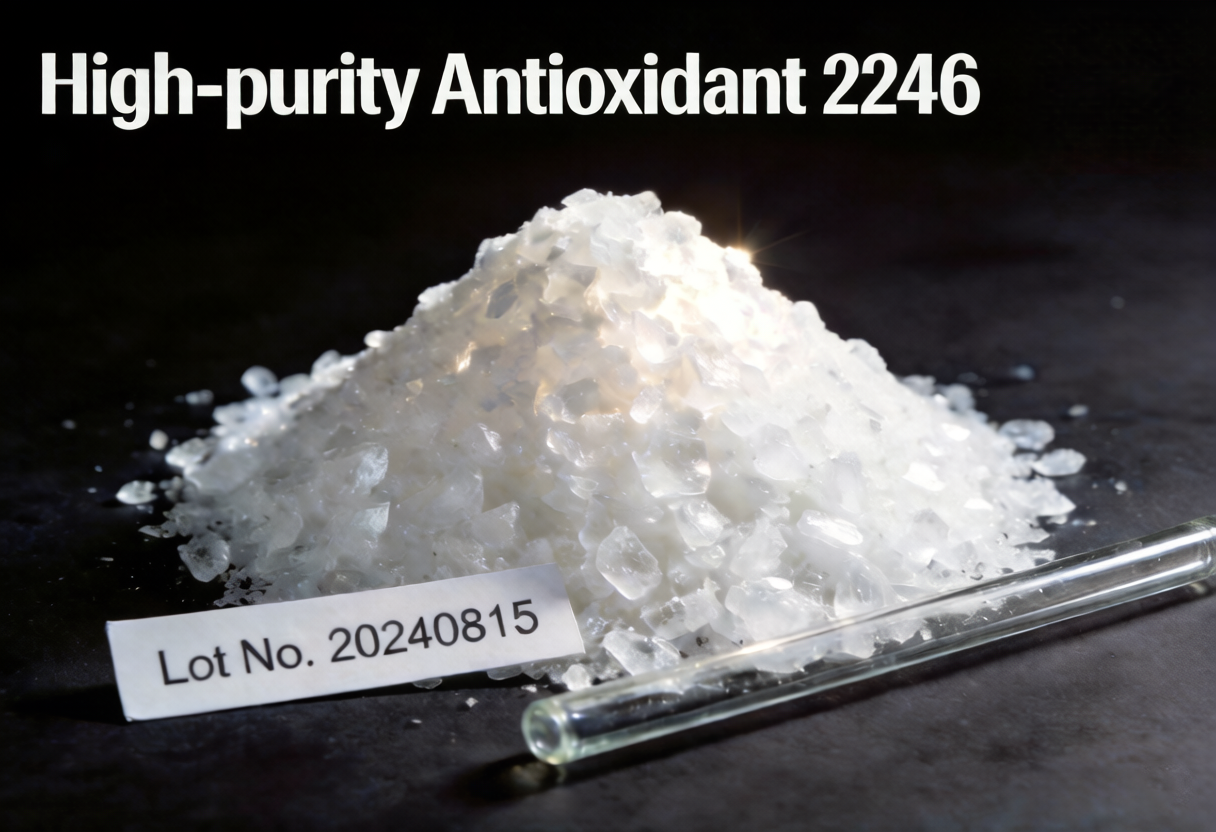
Produk tulen adalah serbuk kristal berwarna putih hingga keputih-putihan. Apabila terdedah kepada udara dalam tempoh yang lama, warnanya mungkin menjadi sedikit kemerah-merahan kekuningan, tetapi perubahan warna ini tidak menjejaskan prestasinya. Produk ini mempunyai bau fenolik yang ringan.
Parameter Fizikal Utama
Titik Lebur: 123–133°C
Titik Didih: 428.6°C (760 mmHg)
Ketumpatan: 1.04–1.09 g/cm³
Titik Nyala: 181–195°C
Ketumpatan Pukal: 300–308 kg/m³
Tekanan Wap: <1 hPa
Kemudahan larutan
Antioksidan 2246 menunjukkan ketelusan yang jelas dari segi kelarutannya dalam pelarut-pelarut pelbagai. Ia mudah larut dalam pelbagai pelarut organik, termasuk aseton (175 g/100 ml, 20°C), etanol (154 g/100 ml), etil asetat (134 g/100 ml), toluena (62 g/100 ml), benzena (46 g/100 ml), dan sebagainya, tetapi mempunyai kelarutan yang lebih rendah dalam n-heptana (8 g/100 ml) dan kelarutan yang sangat buruk dalam air (hanya 7 μg/L, 20°C), iaitu secara praktikalnya tidak larut.

IV. Kaedah Sintesis
Proses penyediaan Antioksidan 2246 terutamanya merangkumi dua langkah utama:
Langkah 1: Penyediaan Bahan Perantara
Menggunakan p-kresol sebagai bahan mentah, 2-tert-butil-4-metilfenol disediakan melalui tindak balas alkilasi dengan isobutilena pada suhu sekitar 60°C di bawah tindakan pemangkin resin pertukaran ion asid kuat 732#. Setelah tindak balas selesai, pemangkin dituras keluar dan hasil turasan dirawat dengan larutan metanol-natrium hidroksida untuk mengendapkan antioksidan 264 sebagai hasil sampingan.
Langkah 2: Tindak Balas Pengondensan
2-tert-butyl-4-metilfenol yang diperoleh mengalami tindak balas kondensasi dengan paraformaldehid dalam pelarut emulsi akueus, dengan asid sulfurik pekat dan natrium dodesilbenzena sulfonat dalam sistem tindak balas. Parameter proses yang dioptimumkan: n(2-tert-butyl-4-metilfenol):n(paraformaldehid) = 2:1.06, suhu tindak balas 83–86°C, masa tindak balas 4.5 jam, hasil melebihi 75%. Setelah produk tindak balas dinetralkan, dituras, dibasuh, dikeringkan, ditumbuk, dan dibungkus, produk siap dihasilkan.
Setiap tan produk menggunakan kira-kira 1600 kg p-metilfenol, 1600 kg isobutilena, dan 400 kg formaldehid (40%).
V. Ciri-Ciri Prestasi
Sebab Antioksidan 2246 menjadi antioksidan am umum yang banyak digunakan terutamanya disebabkan oleh prestasi cemerlang berikut:
● Kestabilan Termal Tinggi: Mampu mengekalkan kesan antioksidan yang baik dalam persekitaran suhu tinggi
● Kesan Antioksidan yang Ketara: Prestasi antioksidannya lebih unggul berbanding Antioksidan 264
● Tidak Mencemarkan: Tiada pencemaran terhadap produk, tidak toksik, tidak menyebabkan perubahan warna, terutamanya sesuai untuk produk berwarna terang dan berwarna cerah
● Tidak Berbloom: Tiada fenomena pengendapan pada permukaan semasa digunakan
● Kelarutan Minyak yang Baik: Penyebaran yang baik dalam matriks polimer, mudah dioperasikan
● Tidak Hilang Melalui Pengevaporan: Ketidakvolatilan yang rendah menjamin kestabilan jangka panjang
● Kompatibiliti yang Cemerlang: Tiada kesan terhadap vulkanisasi dan kelenturan getah, tiada kesan mendestabilkan terhadap lateks
● Dos Rendah: Biasanya penambahan sebanyak 0.1–1.0% sudah mencukupi untuk mencapai kesan pelindung yang baik
VI. Bidang Aplikasi
1. Industri Getah
Antioksidan 2246 merupakan antioksidan ideal untuk getah sintetik, lateks, dan getah asli. Sebagai salah satu varieti unggul dalam kumpulan antioksidan fenolik, produk getah yang ditambah dengan antioksidan ini mempunyai fungsi-fungsi berikut:
Anti-Penuaan Akibat Pengoksidaan Termal: Menangkap radikal bebas dalam getah secara berkesan, menghalang tindak balas pengoksidaan berantai, melambatkan proses penuaan getah pada suhu tinggi, serta mencegah getah menjadi keras dan rapuh akibat pengoksidaan
Pencegahan Penuaan Foto-Ozon: Meningkatkan ketahanan cuaca getah, mengurangkan fenomena penuaan yang disebabkan oleh faktor semula jadi seperti sinaran matahari dan perubahan kelembapan
Pencegahan Kerosakan Akibat Deformasi Berulang: Boleh meningkatkan kelenturan getah dan mengurangkan retak serta pecah yang disebabkan oleh tekanan mekanikal
Penyahaktifan Garam Logam Berbilang Nilai: Produk getah sering mengandungi ion logam berbilang nilai seperti kuprum dan besi. Antioksidan 2246 boleh menjalani tindak balas pengkompleksan dengan ion logam ini untuk membentuk sebatian stabil, seterusnya menghalang pengoksidaan yang dipantas oleh logam
Khusus sesuai untuk produk getah berwarna terang dan berwarna, serta produk getah yang direndam dalam lateks, produk lateks perubatan dan sanitari, dll.

2. Industri Plastik
Dalam industri plastik, Antioksidan 2246 boleh menghalang penuaan haba dan penuaan akibat cahaya pada pelbagai jenis plastik. Aplikasi khususnya termasuk:
Poliolefin: Polietilena, Polipropilena
Plastik Kejuruteraan: Resin ABS, Polioksimetilena (POM), Polieter terklorin, Poliuretana
Lain-lain: Polistirena tahan-impak, Resin selulosa
Antioksidan ini boleh meningkatkan ketahanan haba produk plastik secara ketara, mengekalkan warna dan kejelasan produk, serta memperpanjang jangka hayat penggunaannya. Dos yang digunakan ialah 0.1–1.0%.

3. Produk Petroleum
Sebagai bahan tambah antioksidan untuk produk petroleum, Antioksidan 2246 mempunyai ciri-ciri berikut:

Aplikasi Lain
Antioksidan 2246 juga boleh digunakan dalam bahan pembungkus makanan, peranti perubatan, dan produk lain yang memerlukan tahap keselamatan tinggi. Ciri toksisitas rendahnya memberikan kelebihan ketara dalam aplikasi ini.
VII. Toksisiti dan Keselamatan
Data Toksisiti
LD₅₀ oral tikus: 4880–6500 mg/kg
LD₅₀ dermal tikus: >2000 mg/kg
Berdasarkan pengelasan toksisiti akut, Antioksidan 2246 tergolong dalam sebatian bertoksisiti rendah.
Sijil Peraturan
Diluluskan untuk digunakan dalam bahan pembungkus makanan di Amerika Syarikat, Jerman, United Kingdom, Itali, Jepun, dan negara-negara lain
Had dos maksimum Jepun: Polietilena dan polipropilena 0.1%, Polistirena 0.4%, resin AS 0.6%, resin ABS 2%, PVC (polivinil klorida) 2%
Peraturan FDA Amerika Syarikat: Untuk poliolefin tidak melebihi 0.1%, produk tidak boleh bersentuhan dengan makanan yang mengandungi lemak pada permukaannya
Mematuhi peraturan FDA Amerika Syarikat 175.105 (perekat pembungkus makanan) dan 177.2600 (artikel getah yang direka untuk sentuhan berulang dengan makanan)
VIII. Penyimpanan dan Pembungkusan
Syarat penyimpanan
Produk disimpan di tempat yang sejuk dan kering, dengan mengelakkan suhu tinggi dan kelembapan tinggi. Produk yang telah dibungkus harus dielakkan daripada terdedah kepada cahaya matahari secara langsung. Dalam keadaan penyimpanan yang sesuai, produk dapat mengekalkan kestabilan dan keberkesanannya selama lebih daripada 12 bulan.
Bentuk pembungkusan
Dibungkus dalam beg komposit 20 kg, dengan berat bersih 20 kg setiap beg, dilapisi dengan beg polietilena untuk memastikan keselamatan produk semasa pengangkutan dan penyimpanan. Spesifikasi pembungkusan lain boleh disediakan mengikut keperluan pelanggan.
Amaran Keselamatan
Simbol Bahaya: Xi (Iritan), Xn (Membahayakan)
Kod Kelas Bahaya: R36 (Iritasi terhadap mata)
Arahan Keselamatan: S26 (Jika berhubung dengan mata, basuh serta-merta dengan banyak air dan dapatkan nasihat perubatan), S36 (Pakai pakaian pelindung yang sesuai)
IX. Piawaian Kualiti Produk
Petunjuk teknikal utama bagi Antioksidan 2246 gred industri termasuk:
Penampilan: Serbuk putih hingga putih kusam
Titik Lebur Awal: ≥120.0°C
Kehilangan akibat Pengeringan: ≤0.5%
Kandungan Abu: ≤0.3%
Kehalusan (melalui penapis 100 mesh): ≥99.5%
Kandungan: ≥95.0%

X. Pasaran dan Prospek Pembangunan
Sebagai antioksidan am umum yang digunakan secara meluas, Antioksidan 2246 mempunyai ramai pengilang di seluruh dunia. Menurut statistik, terdapat kira-kira 435 syarikat yang menghasilkan produk ini secara global, dengan 341 daripadanya berada di China, menunjukkan bahawa China telah menjadi pengeluar dan pengguna penting produk ini.
Dengan peraturan alam sekitar yang semakin ketat dan perluasan berterusan bidang aplikasi industri, Antioksidan 2246 mempunyai prospek aplikasi yang luas dalam industri seperti getah, plastik, dan petroleum disebabkan ciri-cirinya yang beracun rendah, berkesan tinggi, dan tidak mencemarkan. Khususnya dalam bahan pembungkusan makanan bertaraf tinggi, peranti perubatan, dan bidang lain yang mempunyai keperluan keselamatan yang sangat tinggi, Antioksidan 2246 akan memainkan peranan yang lebih penting.

Kesimpulan
Dengan prestasi antioksidannya yang sangat baik, keserasian yang baik, toksisitas rendah, dan kebolehsesuaian aplikasi yang luas, Antioksidan 2246 telah menjadi bahan tambahan penting yang tidak dapat digantikan dalam industri seperti getah, plastik, dan petroleum. Dengan perkembangan sains bahan dan perluasan bidang aplikasi, Antioksidan 2246 secara tak terelakkan akan memainkan peranan yang lebih penting lagi dalam meningkatkan kualiti produk, memperpanjang jangka hayat penggunaan, serta mendorong pembangunan industri yang mampan.