
Heat exchangers are among the most common and critical pieces of equipment in chemical production. Their core function is to transfer heat between different fluids. In chemical production processes, almost every step involves heat input, output, or recovery, and heat exchangers are the key devices that accomplish these tasks. Without the effective operation of heat exchangers, modern chemical production would struggle to operate efficiently, economically, and safely.
According to statistics, in modern chemical projects, heat exchangers typically account for 30%-40% of total equipment investment, and in some oil refining or petrochemical projects, this figure can reach as high as 50% or more. Whether the heat exchanger selection is reasonable directly affects the stability of the production process, energy consumption levels, and project return on investment.
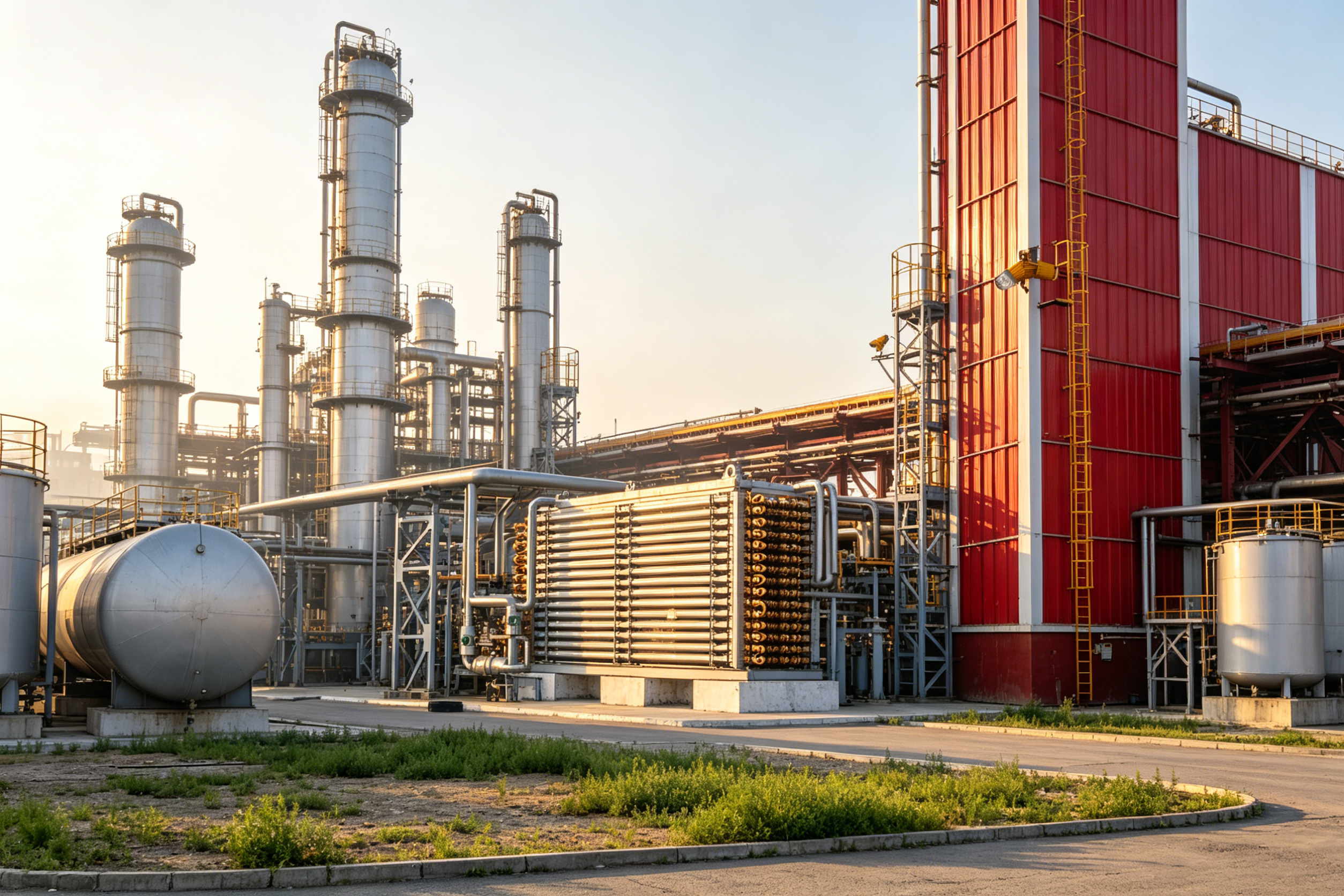
Many chemical reactions in production require specific temperature ranges to proceed smoothly. Excessively high temperatures can lead to increased side reactions, product decomposition, and even safety incidents; excessively low temperatures can cause slow reaction rates and decreased conversion rates. Heat exchangers provide heat needed for reactions or remove heat released by reactions, maintaining optimal temperature conditions within reactors. For example, in the ammonia synthesis process, heat exchangers are used to control reactor temperatures while recovering heat from high-temperature reaction gases to preheat feed, significantly improving overall energy efficiency.
Chemical production is typically an energy-intensive industry, with energy costs accounting for a significant portion of production expenses. Heat exchangers play a crucial role in energy conservation and consumption reduction. Through waste heat recovery systems, heat exchangers can transfer heat from high-temperature exhaust gases and waste liquids to cold materials that need heating, thereby reducing external heating medium consumption. For instance, in petroleum refining, overhead products from atmospheric and vacuum distillation units are at high temperatures; using heat exchangers to preheat crude feed can dramatically reduce fuel consumption in furnaces. This concept of cascaded heat utilization is at the core of modern chemical energy-efficient design.
In separation operations such as distillation, evaporation, and drying, heat exchangers are equally core equipment. Distillation columns require reboilers to provide heat to bottom liquids to generate rising vapor, and condensers to condense overhead vapor into liquid, enabling gas-liquid mass transfer separation. In evaporation operations, heat exchangers provide heat to solutions to vaporize solvents, achieving solution concentration or solvent recovery. These separation processes directly affect product purity, yield, and quality; the performance of heat exchangers directly impacts separation effectiveness.
Many chemical materials are heat-sensitive; prolonged heating or excessive temperatures can cause degradation, polymerization, or even dangerous decomposition. Heat exchangers allow precise control of material heating or cooling processes, avoiding localized overheating or excessive temperatures. Additionally, for some high-temperature equipment, heat exchangers are needed to cool equipment bodies or key components, preventing material strength reduction or creep failure due to high temperatures. Certain flammable and explosive media require strict temperature control during operation; heat exchangers combined with temperature control systems can effectively prevent thermal runaway incidents.
In industries such as fine chemicals and pharmaceuticals, product purity requirements are extremely high. Heat exchangers enable rapid, uniform heating or cooling, reducing material residence time in high-temperature zones, thereby suppressing side reactions. Additionally, efficient heat exchange capacity can shorten batch production cycles and increase output per unit time. For example, in polymerization reactions, rapid removal of reaction heat can control molecular weight distribution, thereby improving the mechanical properties and processability of polymer products.
There are many types of heat exchangers commonly used in chemical production, each with its structural characteristics and applicable scope. Correct selection and design of heat exchangers are critical for ensuring process effectiveness, reducing energy consumption, and controlling investment costs.
Shell and tube heat exchangers are the most widely used and longest-standing type of heat exchangers, with robust construction and high reliability. They consist of a cylindrical shell and a bundle of tubes inside. One fluid flows inside the tubes (tube side), while the other flows outside the tubes but inside the shell (shell side). Baffles are often installed inside to enhance shell-side heat transfer.

Advantages: Strong ability to withstand high temperatures and pressures, wide application range, diverse material options, and easy mechanical cleaning of the tube side. Disadvantages: Lower heat transfer efficiency compared to some high-efficiency types, and larger size.
Applications: Crude oil preheating in atmospheric and vacuum distillation units in oil refining, slurry cooling in catalytic cracking, synthesis gas waste heat boilers and ammonia condensers in ammonia and methanol processes, high-pressure reactor feed/effluent heat exchange in fine chemicals, and utility services such as steam heating and circulating water cooling.
Plate heat exchangers consist of a series of thin metal corrugated plates stacked together, sealed with rubber gaskets between plates. They are a highly efficient and compact new type of heat exchanger. Two fluids flow through alternating plate channels, achieving high-efficiency heat transfer as they flow at high speeds between corrugated plates.

Advantages: Very high heat transfer efficiency, with overall heat transfer coefficients 2-5 times that of shell and tube types; compact structure, small footprint; flexible heat transfer area adjustment by adding or removing plates; easy disassembly and cleaning; ability to achieve "close approach" heat exchange of 1-2°C, very beneficial for waste heat recovery. Disadvantages: Limited by gasket materials, not suitable for high temperatures and pressures (typically ≤200°C, ≤2.5MPa); narrow plate channels susceptible to blockage by large particles.
Applications: Rapid heating and cooling in dairy, food, and beverage industries; heat-sensitive material handling in fine chemical and pharmaceutical industries; water-water heat exchange in HVAC and district heating; small-scale waste heat recovery.
Finned tube heat exchangers have fins added to the outer or inner surfaces of base tubes to expand the heat transfer area, characterized by their "extended surface." They are commonly used for gas-liquid or gas-gas heat exchange.

Advantages: Effectively address the bottleneck of low heat transfer coefficients on the gas side; heat transfer area per unit volume is much larger than that of bare tubes; operating conditions can be matched by varying fin parameters. Disadvantages: Higher flow resistance; fins are difficult to clean once dust accumulates; should be avoided for media prone to coking or with very high dust content.
Applications: Air heating or cooling (e.g., hot air drying, air coolers); process gas waste heat recovery (e.g., flue gas waste heat boilers for reformers); boiler economizers; engine cooling.
Spiral plate heat exchangers are formed by rolling two parallel thin metal plates into two concentric spiral channels, with two fluids flowing counter-currently in the channels. Their structural characteristic is single-channel flow with no dead zones.

Advantages: Particularly suitable for handling viscous liquids or suspensions containing small amounts of solids. The centrifugal effect within the spiral channels enhances heat transfer, provides self-cleaning ability, resists fouling, and has a relatively compact structure. Disadvantages: Complex manufacturing; internal leaks are almost impossible to repair; pressure-bearing capacity generally lower than shell and tube types.
Applications: Heat exchange of high-viscosity materials (e.g., polymers, resins, heavy oils); handling fluids containing solid particles (e.g., wastewater, slurries, reaction effluents containing catalyst particles); steam condensation and chemical solvent recovery where strict counter-current flow is needed to reduce discharge temperatures.
In practical engineering, heat exchanger selection requires comprehensive consideration of multiple factors. Different types of heat exchangers have their strengths. The table below provides reference directions for selection:
| Factor | Preferred Choice | Reason |
|---|---|---|
| Temperature/Pressure | High T/P → Shell and tube | Robust construction, safe, reliable |
| Low T/P → Plate | High efficiency, small footprint | |
| Heat Transfer Efficiency | Pursuing high efficiency → Plate or spiral plate | Strong turbulence, high heat transfer coefficient |
| Allowable Pressure Drop | Pressure drop sensitive → Shell and tube | Adjustable through design |
| Higher allowable ΔP → Plate | High flow velocity yields high pressure drop | |
| Medium Characteristics | Clean, low viscosity → Plate | Narrow channels, not prone to blockage |
| Dirty, viscous, solids-containing → Spiral plate or wide-gap shell and tube | Self-cleaning or no dead zones | |
| Gas-Gas Heat Exchange | → Finned tube | Extended surface compensates for low gas-side heat transfer coefficient |
| Maintenance/Inspection | Frequent cleaning required → Plate (gasketed, removable) | Plates can be disassembled and flushed |
| Shell side also requires cleaning → Floating head or U-tube shell and tube | Tube bundle can be withdrawn |
Heat exchangers play the critical role of "thermal regulators" in chemical production. They are not only core equipment for maintaining reaction conditions and achieving separation and purification but also crucial means for energy conservation, safety assurance, and product quality improvement. From robust shell and tube to highly efficient compact plate, from finned tubes excelling in gas-gas heat exchange to self-cleaning spiral plate, various types of heat exchangers play irreplaceable roles in their respective application areas. As the chemical industry moves toward green and low-carbon development, new high-efficiency, compact, and corrosion-resistant heat exchanger technologies continue to emerge, and their value in improving energy efficiency and reducing carbon emissions will become increasingly prominent.
Need help selecting the right heat exchanger for your chemical process? Contact our engineering team for a no-obligation consultation.
 EN
EN